Full Html
Variance of an Individual's Rate of Growth within a Rasch Population Meta-Meter
Full Html
1. Introduction
The Danish mathematician and statistician Georg Rasch (Andersen & Wohlk Olsen, 2001; Andrich, 2005) is well known for his measurement theory based on the principle of invariant comparisons (Rasch, 1960, 1961). In contrast, he is hardly known for his studies in physiological growth based on the same principle, both of which are consistent with formulations of relationships amongst variables in the natural sciences. His approach identifies a transformation of time, called the meta-metre, which characterises the growth for all members of a population. Then within the meta-metre, individual rates of growth can vary, with each individual’s rate of growth linear and therefore invariant across the meta-metre (Rasch, 1977). Andrich, Marais and Sappl (2023) adapted Rasch’s approach to the measurement of growth on variables of the social sciences, and in particular intelligence and attainment tests in reading and mathematics. Although they provided estimates of the meta-metre and rate of growth of individuals within the meta-metre, they did not provide an estimate of the error variance of an individual’s estimate of the rate of growth. This paper is concerned with this topic.
Before proceeding we note that the approach is novel, and had only been applied by Rasch (Wohlk Olsen, 2003) and Rao (1958) to the growth in weight of young animals and human babies respectively. We recognise the presence of current methods of studying growth in the social sciences, for example structural equation modelling summarised by Wang & Nydick (2020), but there is no space to compare and contrast these methods in this paper. An approach to growth on social science variables that is analogous to that of the natural sciences has also been advocated by, among others, Williamson (2018). However, those methods involve modelling in the form of polynomial regression and are primarily descriptive and group based, rather than explanatory and individual focussed.
1.1 Some distinctive features of the meta-metre approach to growth
Because the meta-metre approach is novel, we summarise some of its key features before proceeding to the main purpose of the paper. First, both the function of the estimated meta-metre and the rates of growth of individuals and subpopulations become of interest. For example, Andrich et al. (2023) showed that the estimated meta-metres of two intelligence, two reading and two mathematics tests, all had decelerating growth, indicating that the rate of growth was inversely proportional to a function of time. This implies that it becomes more and more difficult to grow on the quantitative scale, and sets up a quest for understanding this phenomenon, broached in Andrich et al. (2023), but which is also beyond the scope of this paper. Their analyses of other longitudinal achievement data showed the same characteristic.
Second, two insights from the decelerating meta-metre were highlighted. One was that the rate of growth in the early years is relatively rapid compared to the later years and that this confirms that this is the time in which to intervene for students at risk; the other, that a small difference on the quantitative scale in the early years, which can imply a small difference on the common grade scale used in schools, invariably implies a greater difference on the grade scale in later years. Often it is implicitly assumed that growth on a quantitative scale is more or less linear, and that it should also be linear on the grade scale (Andrich et al., 2023, Ch. 6).
Third, having, within a meta-metre, the rate of growth characterized by a single value has both conceptual and statistical elegance. For example, it permits standard analysis of variance (ANOVA) procedures to be used in the comparison of mean rates of growth among defined subgroups of a population. Andrich et al. (2023) conducted such analyses comparing performances based on gender and demographic groups. In ANOVA, the error variance of the estimate of each individual is absorbed within the variance among individuals permitting it to proceed without having an estimate of the individual error variance. Establishing an estimate of the error variance of an individual’s rate of growth in a meta-metre is the subject of this paper.
1.2 Adaptations of the meta-metre approach to variables of the social sciences
There are two issues that needed addressing in adapting Rasch’s concept of a meta-metre of growth to social science variables. First, Rasch and Rao could assume a natural origin for weight. However, in social science tests, the origin is arbitrary, and Andrich et al. (2023) successfully adapted Rasch’s approach to account for this feature. Second, in Rasch’s formulation of a stochastic process of growth, it was assumed that the successive differences of measurements, which are used in the estimation and which are summarised below, were independent. This independence is tenable in part under two general conditions: first, if, relative to the range of measurements, the measurement error is negligible; second, if the rate of change of individuals between time points shows very little variation. Both might be tenable for the growth of babies or animals in their first year. In social science tests however, as illustrated below, neither the magnitude of the measurement error nor the potential variation in the amount of growth between time points of an individual can be ignored across a relatively large time scale. Both properties show features of general regression to a true value that cannot be ignored in establishing an error variance for the rate of growth of an individual.
Although the methods of estimation of the individual rate of growth are analogous to those of standard regression analyses, there are two main differences. First, because of repeated measures, successive differences rather than observed measurements are used in the estimation; second, in addition to the study of the rate of growth in means of a population, the focus is on estimating the rate of growth of each individual. It is noted that the studies of this paper, though derived directly from the equation for estimating an individual’s rate of growth, are in part heuristic, taking advantage of modern computing facilities for conducting simulations. They are not seen as the final word on the estimates of the errors of the rates of growth, or indeed on the estimates of the rates of growth themselves for test data typically found in social science instruments. They are intended to generate further studies on both topics.
The rest of this paper is structured as follows. Section 2 summarises the adaptation of Rasch’s formalisation of a meta-metre of growth for social science variables, Section 3 provides variances of the estimates of an individual’s rate of growth, Section 4 shows the results of two simulation studies and Section 5 suggests further research. In addition, two Appendices are provided, one shows the derivation of the estimation equations; the second presents a general discussion on the generic concept of regression to the true value in the presence of random variation.
Although it is elaborated at the end of Appendix 2 because of context, it is anticipated here that the general theme of the analyses presented in this paper is that of probabilistic regression to the true value, a subtle and ubiquitous property of replications in the presence of random variation. Although related to, it is not the same concept to the description of fitting a model typically referred to as a regression analysis.
2. The meta-metre of growth and its estimate
Formally, let  be a measurement of an individual on some variable, such as on an intelligence, reading or mathematics test, at time
  with an arbitrary origin. Although the origin may be arbitrary, it is assumed that the measurements are of the form commonly known as interval level which follow, for example, if measurements are estimated by a Rasch model of modern test theory (Andrich & Marais, 2019; Rasch, 1960). Then
 (1)
(1)
is the linear growth of individual  as a function of time
  in the meta-metre
  ,
,  is the true value of individual at time ,
  is measurement error assumed to be homogeneous among individuals and times of measurement, and normally distributed. We return to this point later in the paper.
An important feature of Eq. (1) is that it characterises dynamic consistency in which the function of growth of an individual is the same as the function of growth of the population (Keats, 1982). Thus, taking the mean of a population, and replacing the subscript over which the mean is taken by “.”, gives
 , (2)
, (2)
where  respectively characterise the mean rate of growth and initial status of the population. Eq. (2) is used to estimate the meta-metre for the population.
2.1 The meta-metre for growth in weight and intelligence and attainment tests
In the examples of growth on some intelligence and attainment tests, Andrich et al. (2023) were able to characterise growth in the meta-metre by
 , (3)
, (3)
where  is the value of the time variable at each occasion of measurement,
This function is identical to the one used by Rasch to characterise growth in weight. The estimates of  were in the range
  for the intelligence tests and
  for the reading and mathematics tests. The kind of growth in these tests showed consistent deceleration, thus making the logarithmic function an obvious one to consider for the meta-metre. From graphical representations and the values of the regression correlations of the order of
  , together with other evidence, it was concluded that the meta-metre for each population was estimated fully successfully.
The parameter has two roles. First, it governs the rate of deceleration, with the greater the value of the smaller the deceleration; second, it sets a form of origin, permitting the first time point to take some arbitrary, convenient value. For example, in growth in educational attainment tests, the first time can be set as either a grade (e.g. 1 for Grade 1) or an age (e.g. 6 for children being on average six years old), whichever is deemed convenient.
2.2 An adaptation of Rasch’s method of estimation
Rasch’s method of estimation of the parameters in Eq. (2) is that of least squares, which we follow. There are alternative approaches within this general method, but the one used for this paper is shown in Appendix 1. It is somewhat more efficient than that applied in Andrich et al. (2023). In summary, to estimate for the population for the meta-metre of Eq. (3), advantage is taken of dynamic consistency, and the means  are used as the relevant data. Then the estimation equations are
 (4)
(4)
 (5)
(5)
where  and
and  are successive differences of the means and of the meta-metre respectively. The derivation of the equations, which must be solved iteratively, are shown in Appendix 1.
Having confirmed the adequacy of the meta-metre with the estimate of for the population, the least squares estimate of the rate of growth  of individual is given by Eq. (6) (Andrich et al., 2023):
 (6)
(6)
The estimate of the intercept  for individual , given
  and , can be obtained from the standard regression equation
 . (7)
. (7)
Because this paper is concerned with estimates of  and their standard errors, the rest of the paper does not refer to .
3. The general form of the error variance of the rate of growth
From Eq. (6),
 , (8)
, (8)
and because  is a constant given
  ,
,
 (9)
(9)
3.1 Covariances of successive differences
Given the denominator of Eq. (9) is a constant, we first expand its numerator giving


 , (10)
where  .
.
In summary
 . (11)
The values  are within person variances and covariances of successive differences. Clearly if the differences
  were statistically independent, then
However, because of regression effects of measurement error and variable growth between time points, both of which are assumed to be normally distributed in the population, the covariance,  between two successive differences
  is most unlikely to be zero. To avoid a break in the continuity of the derivations, a discussion on the principle of using differences
  for the estimation, and the reasons they lead to regression, are discussed in more detail in Appendix 2.
In summary, regression appears because if a measurement on the first occasion is say noticeably greater than its true value, then on a replication, the second measurement is more likely to have a value less extreme than the first measurement and generally closer to the true value than the first measurement. This is because in a normal distribution in particular, the probability of a large discrepancy from the true value is smaller than the probability of a small discrepancy (Andrich & Pedler, 2019).
3.2 The presence and evidence of a measurement error
For further exposition, we elaborate our terminology. From Eq. (1) is the unknown, presumed true value of an individual on the variable being measured at time . We refer to this value as the measure of individual  Then the observed value of the variable, of Eq. (1) we refer to as a measurement. This measurement has an error, denoted with variance
  , which formalises Eq. (1) and for convenience is reproduced as Eq. (12):
 (12)
(12)
To be consistent with the measurement context considered below, for the remainder of the exposition we replace with the estimate  .
.
In the typical social science context, with an estimate , its error variance  is provided. For example, in the context of educational, psychological, or health outcomes assessment, individuals respond to a test or questionnaire composed of a set of items assessing different aspects of the same variable. These tests may be attainment assessments such as mathematics, reading or intelligence tests, referred to above in Andrich et al. (2023), or tests or questionnaires that might be used in health outcomes, for example in Christensen, Kreiner and Mesbah (2013). If the responses are analysed according to models of modern test theory (Van der Linden, 2016), and in particular Rasch measurement theory (Rasch, 1960, 1961; Andrich & Marais, 2019), an estimate with a standard error of this estimate,
  , are provided. These are provided by the theory of maximum likelihood (ML) estimation typically employed. Because of the large literature on estimation in the Rasch model, we do not elaborate on this topic here. However, for completeness, Appendix 1 has a summary of the ML estimation equations for the estimate of individual parameters and their standard errors in the dichotomous Rasch model for measurement, which is used in the simulation studies in Section 4. It also confirms, from the simulation, the accuracy of these equations.
Thus, we take that each individual has a measurement and an estimate of its error variance , where this variance varies among individuals. Therefore, when the only error is measurement error, we can write


 . (13)
We distinguish the notation for  when obtained directly within an individual over times of measurement and when derived from measurement error alone: the former, introduced in Eq. (11), is
  the latter introduced above in Eq. (13) is further subscripted by
  ,
, 
Eq. (13) shows that, in the context with which we are concerned, it provides an estimate of a component of the first term in the numerator of Eq. (11), that of the within individual error variances,  . However, there is no obvious estimate for an element of the second term, , that which involves the within individual covariances. We study further analysis of this term, augmented with simulated data, and suggest a possible estimate of . Incidentally, we note that for the variance
  across individuals, we again need to concern ourselves with the covariance
  .
.
4. Simulation studies
This section provides the results of two simulation studies which illustrate the validity of Eq. (11) in the presence of measurement error and some variable rates of growth across time for each individual. Unlike in real data, in simulated data the measures are known, and we use this knowledge in interpreting the results of the simulations.
4.1 Simulation 1: only source of variance is measurement error
The variance associated with the successive differences can in principle come from two sources: first, as indicated above, from the measurement error; second from different rates of growth between times of measurement within an individual. To provide a frame of reference for the study of  in the realistic context where both forms of variance are present, the first simulation has the measurement error as the only source of variance. Simulation 2 then has, in addition to measurement error, variation within each individual’s rate of growth across times of measurement.
4.1.1 Input parameters for Simulation 1
First, 2500 individuals with measures were drawn from a normal distribution with a specified mean and standard deviation,  , at time
  Second, each individual had the same linear rate of growth in the same meta-metre between the successive time points, giving measures at each successive time point. The parameters of the meta-metre and measures are based on examples of real data (Andrich et al., 2023), with measurements taken on seven occasions, beginning in Kindergarten and occurring at varying times with the final assessment taken in Grade 12. In anticipation of the notation for Simulation 2, we note that the correlation between successive measures is 1.0, and denote Simulation 1 by
  .
.
Table 1 shows the specified value of the meta-metre, and distribution of individuals at each time of measurement.
Table 1.
The meta-metre and specified distribution for the grades  at each time of measurement
  .
.
| |||||||
| |||||||
Occasion | 1 | 2 | 3 | 4 | 5 | 6 | 7 |
Grade | 0 | 2 | 3 | 6 | 8 | 9 | 12 |
Specified parameters | |||||||
| -1.690 | -0.080 | 0.250 | 0.870 | 1.140 | 1.250 | 1.530 |
| 0.160 | 0.160 | 0.160 | 0.160 | 0.160 | 0.160 | 0.160 |


Figure 1 shows the interpolated, decelerating growth in means of the measurements as a function of the grade. In anticipation of the estimate of the meta-metre, Panel 2 of Figure 1 shows the linear rate of growth in the estimated meta-metre.
Panel 1 | Panel 2 |
|
|
Figure 1. Interpolated growth in means of measures as a function of grade | |


4.1.2 Observing estimates of measures and their standard errors
To study errors of measurement from typical social science contexts, each individual with measure was simulated to respond to a test composed of 60 items, scored correct or incorrect, according to the dichotomous Rasch model (Rasch, 1960). In the design, it was ensured that the range of item difficulties was wide enough that the measurements were not contaminated by floor or ceiling effects. These responses were then analysed with the same Rasch model giving individual estimates and their standard errors, . These analyses were conducted using the software RUMM2030Plus (Andrich, Sheridan & Luo, 2023). Again, to avoid breaking continuity, the results of the summary statistics, which confirm the consistency of the analyses with the specified parameters, and the accuracy of the estimates of parameters, are also shown in Appendix 1.
The key feature of Simulation 1 is that, although the individuals have different initial measures, because the rate of growth of all individuals is identical, from the perspective of the rate of growth the individuals are replications of each other. We take advantage of this feature in the study. To further confirm the validity of the results, a number of simulations with the same principles as just described, but different parameters, were carried out. Because the results were identical across these simulations, for illustrative purposes only that of one pair of simulations is reported in this paper.
We stress that we are not attempting to obtain an empirical distribution of the error estimates in the individual rate of growth by carrying out multiple simulation studies in this paper, but to give analytic and illustrative direction to studying a specific feature in the estimation of this error, namely the effect of regression between successive measurements. A sample of 2500 was considered sufficiently large to provide stability in the estimates to illustrate these effects.
4.1.3 Results of analyses of error variances and covariances of the differences 
The variances and covariances, respectively, are the key statistics of Eq. (11) for estimating the variance of an individual’s estimated rate of growth,  . Table 2 shows these from both the measures
  and their estimates . For the measures, as expected, the variances and covariances are zero. However, in addition to positive variances, the covariances of the successive differences in the estimates are noticeably negative. This is a direct result of regression to the mean, mentioned above and discussed in some detail in Appendix 2. Interestingly, the covariances of the estimates that are not successive are virtually zero and in practice could be ignored. It is also evident from Table 2 that the mean of the ML estimates of the individual error variances
  give a very accurate estimate of the actual variances,
 .
.
Table 2.
Variances  and covariances
  of
of  among individuals in measures below, and measurements above, the diagonal, together with the mean of error variances
  derived from Eq. (13).
Grade |
| 2 | 3 | 6 | 8 | 9 | 12 |
| 0.249 | 0.228 | 0.232 | 0.239 | 0.244 | 0.252 | |
| 0.246 | 0.226 | 0.231 | 0.247 | 0.240 | 0.251 | |
2 | 0.000 |
| -0.109 | -0.002 | -0.005 | 0.004 | 0.000 |
3 | 0.000 | 0.000 | -0.113 | 0.002 | -0.001 | -0.004 | |
6 | 0.000 | 0.000 | 0.000 | -0.122 | 0.002 | 0.006 | |
8 | 0.000 | 0.000 | 0.000 | 0.000 | -0.119 | -0.005 | |
9 | 0.000 | 0.000 | 0.000 | 0.000 | 0.000 | -0.119 | |
12 | 0.000 | 0.000 | 0.000 | 0.000 | 0.000 | 0.000 |


4.1.4 Estimate of 
Table 3 shows the population estimates of and  from both the simulated measures
  of the individuals and the estimated measurements
 . The estimates are shown correct to three decimal places with the solution to Eqs. (4) and (5) being correct to four decimal places. The estimate is close to the specified value, and the mean rate of growth
  of the individual estimates is identical to the population estimate
  with predictably, those from the measures somewhat more accurate than from their estimates, which include random errors of measurement. Figure 1, Panel 2, showed the linear growth in the means as a function of the estimated population value of in the meta-metre with
  . Therefore, together with the details shown in Appendix 1, the simulation was considered valid and sufficiently stable to illustrate the study of the estimates of error variance of individuals’ rates of growth.
Table 3.
Estimates of  from the measures and estimates together with summary statistics for three estimates of
  , where
  .
.
Values |
|
|
|
|
|
| |
Specified | 0.500 | 1.000 | |||||
Measures | 0.502 | 1.002 | 1.002 | 0.000 | 0.000 | ||
Estimates | 0.516 | 1.019 | 1.019 | 0.055 | 0.055 | 0.056 (0.005) | |


4.1.5 Analyses of error variances of estimates 
Table 3 also shows three estimates of individual variance .
(i)  , where the subscript (.) again replaces the index across which the variance is taken, is simply the observed variance of the estimates
  It will be recalled that because the rate of growth of individuals is identical making the 2500 cases replications of each other, this variance among individuals, , is also an estimate of the variance within each individual, . Therefore, from the measures which have no measurement error,
  However, because of measurement error, from the estimates,
  . This estimate is used as a criterion for the accuracy of the two other estimates.
(ii)  is obtained by inserting into Eq. (11) the observed variances and covariances,
  of among individuals. As a result, it is the same value for all individuals, justified because the individuals are replications of each other. This estimate depends only on the observed differences . Although calculated differently,
  , indicating that is a correct estimate of
(iii)  , is the mean of the estimates of derived using the error variances within individual estimates. It was calculated as follows. The first term of the numerator of Eq. (11),
  , was calculated from the error variances available for each individual from Eq. (13), giving
  . This value was not identical across individuals. The second term of the numerator of Eq. (11),
  , was obtained from the covariance among individuals. Again, because individuals are replications of each other, the covariance among individuals is an estimate of the covariance within individuals. This value, therefore, was identical across individuals.
The observed variance, , differs by only 0.001 from the other two estimates. The closeness of these two values further confirms, first the accuracy of the ML within individual error variances
  , and second, the need to use covariances in estimating the error variance of the latter, using either or .
Before proceeding to Simulation 2, we consider a second calculation to establish the accuracy of the estimate for Simulation 1. This is to take the estimated mean rate of growth  and apply 95% confidence intervals using the standard error,
  . The number of individuals who are outside these limits is 107, that is 4.3% which is the correct order of magnitude for the 5% confidence limits.
4.2 Simulation 2: source of variance includes measurement error and differences in growth between times of measurement
In Simulation 1, the rate of growth of all individuals is the same. However, in real data there will be variation in the rates of growth, not only among individuals, but some variation among times within an individual.
4.2.1 Input parameters for Simulation 2
Simulation 2 included such variation by specifying  to be the true correlation of measures between successive times of measurement among individuals. Again, this value for the true correlation is of the order of magnitude found in real data analysed by the authors. Otherwise, Simulation 2 has identical parameter specifications to Simulation 1 including responses to 60 dichotomous items according to the dichotomous Rasch model. Details of the specifications and results of analyses of Simulation 2 are provided in Appendix 1. The results of the analyses are consistent with the specifications.
Although the individuals are not replications of each other in the sense that they have identical rates of growth, there is another relevant sense in which there is a relationship between the among and within individual variation in growth. Thus, a true correlation between times of measurement among individuals of 0.7 implies a high measurement on one occasion will tend to be a high measurement on another occasion within an individual, but with individual variation. And in particular, it is likely to show regression. Therefore, overall variances and covariances among individuals may be a useful indicator of the corresponding values within individuals. This is essentially the substance of the study of Simulation 2 and we comment on the use of among individual variances and covariances to estimate the same statistics for within individuals in a later section of the paper where this equivalence is applied.
4.2.2 Results of analyses of error variances and covariances of the differences
The variances and covariances used in estimating are shown in Table 4. As in Simulation 1, the covariances among individuals of successive differences,  , are negative while the others are virtually zero. However, unlike in Table 2 where the covariances among differences in measures are 0.0, the covariances of successive measures in Table 4 all have a slight negative value. This shows that with differences in known measures with no measurement error, there is also an element of regression between two successive times of measurement. This kind of regression is also discussed in Appendix 2. The covariances of non-successive measures are very close to 0.0.
A second difference between Tables 2 and 4 is in the comparison of the mean of  , derived from individual error variances in Eq. (13), and that of the observed variance,
  . In Table 4 the latter is greater having, in addition to measurement error, variation among individuals in the amount of growth among times of measurement.
Table 4.
Variances and covariances  of among individuals in measures below, and measurements above, the diagonal, together with the mean of error variances derived from Eq. (13).
Grade |
| 2 | 3 | 6 | 8 | 9 | 12 |
| 0.235 | 0.226 | 0.231 | 0.248 | 0.257 | 0.253 | |
| 0.340 | 0.330 | 0.336 | 0.338 | 0.328 | 0.347 | |
2 | 0.094 |
| -0.160 | 0.010 | -0.006 | -0.010 | 0.005 |
3 | 0.097 | -0.048 | -0.171 | 0.005 | 0.013 | -0.009 | |
6 | 0.099 | -0.002 | -0.048 | -0.171 | 0.000 | 0.001 | |
8 | 0.099 | 0.000 | 0.001 | -0.050 | -0.168 | 0.000 | |
9 | 0.096 | 0.002 | 0.000 | -0.001 | -0.049 | -0.165 | |
12 | 0.098 | -0.002 | 0.000 | 0.004 | -0.001 | -0.049 |


In comparison to the covariances in Simulation 1, the magnitude of the negative covariances of the successive measurements are greater, around -0.17 compared to -0.10 shown in Table 2. This is again because of a combination of regression due to measurement errors and regression due to differences in measures across times of measurement.
4.2.3 Estimate of
Table 5 shows the estimates of the population parameters, and from both the measures and the measurements. As in Simulation 1, these are close to each other and to their specified values. Figure 2, Panel 2, shows the linear growth in means as a function of the estimated population value of , confirming that the estimated meta-metre summarises observed growth in means excellently.
Table 5.
Estimates of from the measures and estimates together with summary statistics for three estimates of , where  .
.
|
|
|
|
|
| |
Specified | 0.500 | 1.000 | ||||
Measures | 0.496 | 0.999 | 0.999 | 0.020 | 0.020 | |
Estimates | 0.508 | 1.014 | 1.014 | 0.076 | 0.076 | 0.047 (0.005) |

Panel 1 | Panel 2 | |
|
| |
Figure 2. Interpolated growth in means of measures as a function of grade |
| |


4.2.4 Applying among individual covariances to estimate within individual 
In anticipation of further developments in the paper, and as noted above and in Simulation 1, we use the covariances among individuals for the relevant term in Eq. (11) to obtain an estimate of the variance within each individual . We note that the use of among individual variances to estimate a within individual variance has a common precedent. For example, in the standard regression context of say the measurements of a sample of individuals on two variables  , Y dependent on X, which might be the measurement of the same individuals on two occasions, the regression equation is typically written as
  where
where  are parameters that pertain to the population,
  are measurements of an individual , and
  is the residual from the predicted equation with variance
  assumed homogenous among individuals. Then, on standard assumptions, including that the relationship is adequately linear, for a given value of
  ,
,  where is the residual variance calculated among individuals (Draper & Smith, 1966). Thus, the estimated variance of the dependent variable
  for hypothetical replications for an individual with a specific value of , is a function of a variance among individuals with different values on the variable
  We stress, however, that our application of the same principle, does not imply it is the final word on the error variance .
4.2.5 Analyses of error variances of estimates
Table 5 also shows the summary statistics for the individual estimates, . The estimate  from the measures is excellent, but unlike in Table 3 where the growth was uniform, there is a non-zero variance in these estimates,
  . Importantly, , the mean of the estimates of the error variances among individuals, is equal to three decimal places to
The mean  from the estimates
  is also excellent. As expected, the variance
  from the estimates is greater than the corresponding variance, from Table 3, where the only error involved was measurement error. This greater value in Simulation 2 arises because the individuals do not have a uniform rate of growth and contains both the variance among the individuals and the errors of measurement within individuals.
Table 5 also shows the summary statistics estimates calculated in the same way as for Simulation 1 and as for known measures. Particularly noticeable is that  , showing that the mean of the observed variances of estimates among individuals is the same as that calculated from Eq. (11). Because the variances and covariances are the same for all individuals, all individuals have the same error variance.
Finally, Table 5 also shows , which involves the error variances of individual estimates inserted appropriately into Eq. (11). As a consequence, and unlike , this value varies among individuals. However, the mean  , is noticeably smaller than . This results from it not including any variance in the rate of growth within individuals over times of measurement while including the negative covariances. Its value as an estimate of the error variance within an individual appears too small. Its calculation has been used to help understand the components of variance and effects of regression in estimating the variance of the estimate of the rate of growth of an individual.
Subject to further research, however, we suggest, that the estimate may be seen as a lower bound for the actual variance of the estimate in the rate of growth.
To illustrate the application of the lower bound from Table 5, the estimates and confidence intervals of two individuals are shown in Table 6, and graphically in Figure 3. The individual in Panel 1 has an average rate of growth (1.103) and a relatively low error variance (0.045), while the individual in Panel 2 has a larger rate of growth (1.511) and a larger error variance (0.068). Figure 3 shows the observed means, the estimated regression line for the observed means, and the regression lines for the 95% confidence intervals. The observed means are well within the confidence range. The constants of the regression lines have been adjusted to ensure that they begin at the observed measurement at Time 1.
Table 6.
Confidence interval (0.95) for the rate of growth for two individuals, where .
Individual |
|
|
|
|
|
2277 | 0.045 | 0.211 | 0.690 | 1.517 | |
912 | 1.511 | 0.068 | 0.260 | 1.002 | 2.021 |
| |||||


|
|
Figure 3. 95% confidence interval of the rate of growth for | |


5. Conclusion and further research
This paper concerns estimating the error for an estimate in the rate of growth of an individual in a meta-metre of growth which is a linear transformation of time that governs the rate of growth of all individuals. In addition, the variables on which growth is measured are social science variables such as those derived from intelligence and attainment tests. Because the use of a meta-metre is novel, even though Rasch introduced it in the 1950s, the concept and a particular meta-metre is briefly reviewed.
Although analogous to standard regression analysis, there are two relevant differences. First, because of repeated measures over times of measurement, account must be taken of the correlation between measurements. This is done in a standard way by using as a key statistic in the estimation, the successive differences between the measurements. Second, the magnitude of individual errors of measurement are not sufficiently small that they can be ignored. However, with modern test theory analysis of responses to tests, errors of measurement are provided, and as shown in this paper, these can be exploited.
Both the repeated measurements of individuals and their errors of measurement on each occasion lead to regression, a concept and property often ignored. It can be ignored when focussing on group statistics such as growth in means, but play a role when focussing on individuals. From a repeated measures perspective, independent of measurement error, if a person has a somewhat larger growth than expected in one interval of time, then that individual is likely to have a lower growth in the next interval. From an error of measurement perspective, which is assumed and indeed required to be at least unimodal but typically also normal, if a measurement on one occasion has, for example, a large positive measurement error, then it is likely to not be as large on the next measurement. Both contribute to negative covariances of differences of successive measurements. A discussion of regression in such contexts is provided in Appendix 2.
With two simulation studies based on the analytic derivations of the estimate of growth of an individual and an estimate of its variance, both kinds of regression are shown to be present and relevant. Although the paper does not have a final recommendation for a unique estimate of the error variance for an individual’s rate of growth, in the presence of an available measurement error for each measurement of each individual, it does suggest a lower bound. It also suggests further analytic work, possibly augmented as in this paper with simulation studies. However, these further studies must take account of the regression effects described above. The purpose of this paper was not to be definitive, but to give some orientation to this further research.
Acknowledgment
We acknowledge comments, which we took account of, from three Reviewers.
Funding details and disclosure statement
This research was funded in part from a collaboration between the University of Plymouth and The University of Western Australia.
Data Availability Statement
All data reported in the paper were simulated, and available from the first author.
How to Cite
Andrich, D., & Sappl, S. (2026). Variance of an individual’s rate of growth within a Rasch population meta-metre. Educational Methods & Psychometrics, 4 (SAMC 2024 Special Issue): 25.
References
Andersen, E. B. & Wohlk Olsen, L. (2001). The life of Georg Rasch as a mathematician and as a statistician. In A. Boomsma, M. A. J. van Duijn & T. A. B. Sniders (Eds.), Essays in item response theory. Springer: New York.
Andrich, D. (2005). Georg Rasch. In K. Kempf-Leonard (Ed.), Encyclopedia of social measurement (Vol. 3, 299-306). Academic Press: Amsterdam.
Andrich, D. & Luo, G. (2003). Conditional pairwise estimation in the Rasch model for ordered response categories using principal components. Journal of Applied Measurement, 4(3), 205-221.
Andrich, D. & Marais, I. (2019). A Course in Rasch Measurement Theory: Measuring in the Educational, Social and Health Sciences. Springer Texts in Education, Springer: Singapore.
Andrich, D., Marais, I. & Sappl, S. (2023). Rasch Meta-Metres of Growth for Some Intelligence and Attainment Tests. Springer: Singapore.
Andrich, D. & Pedler, P. (2019) A law of ordinal random error: the Rasch measurement model and random error distributions of ordinal assessments. Measurement, 131, 771-781.
Andrich, D., Sheridan, B. S. & Luo, G. (2023). RUMM2030Plus: Rasch Unidimensional Models for Measurement. RUMM Laboratory: Perth, Western Australia.
Bock, R. D. (1975). Multivariate statistical methods in behavioral research. McGraw-Hill: New York.
Christensen, K. B., Kreiner, S. & Mesbah, M. (2013). Rasch models in health. Wiley: London.
Draper, N. R. & Smith, H. (1966). Applied Regression Analysis. John Wiley & Sons: New York.
Keats, J. A. (1982). Comparing latent trait with classical measurement models in the practice of educational and psychological measurement. In D. Spearritt (Ed.), Invitational seminar on the improvement of measurement in education and psychology. ACER: Melbourne.
Rao, C. S. (1958). Some statistical methods for the comparison of growth curves. Biometrics, 14, 1-17.
Rasch, G. (1960). Probabilistic models for some intelligence and attainment tests. Danish Institute for Educational Research: Copenhagen. Expanded edition (1980) with foreword and afterword by B. D. Wright. The University of Chicago Press: Chicago. Reprinted (1993). MESA Press: Chicago.
Rasch, G. (1977). On specific objectivity: an attempt at formalising the request for generality and validity of scientific statements. Danish Yearbook of Philosophy 14, 58-94.
Wang, C. & Nydick, S. W. (2020). On longitudinal item response theory models: a didactic. Journal of Educational and Behavioral Statistics, 45(3), 339-368.
Williamson, G. L. (2018). Exploring reading and mathematics growth through psychometric innovations applied to longitudinal data. Cogent Education, 5. doi: 10.1080/2331186X.2018.1464424
Wohlk Olsen, L. (2003). Essays on Georg Rasch and his contributions to statistics. University of Copenhagen, Institute of Economics: Copenhagen.
Manuscript Received: 04 MAR 2025
Final Version Received: 18 JAN 2026
Published Online Date: 15 FEB 2026
Appendix
Appendix 1. Estimates of parameters in the meta-metre and the dichotomous Rasch model for measurement
A1.1 Estimates of parameters in the meta-metre
In deriving an equation for the least squares estimate of  using Rasch’s approach, it is necessary to distinguish between the value of the variable at the time of measurement, and the continuous variable
  of time. Thus let
  be the time of measurement with
  the index variable. Then in Eq. (1),
  ,
,  has the value of the time of measurement at time
  . For example, if measurements were taken every two years for seven years, and the time of the first measurement was assigned the value
  , then the values at the times of measurement are
  , where
  .
.
Then Eq. (1) is elaborated to
 . (A1.1)
From dynamic consistency and taking the means across the individuals,
 (A1.2)
The parameter  is a population parameter; therefore, we approach its estimate using the means,
  , of the population calculated at the successive time points
  .
.
Least squares estimate of  in the meta-metre as a function of
We first derive a least squares estimate of  . From Eq. (A1.2) we have,

 . (A1.3)
In the notation above, let
 (A1.4)
We note that  has been eliminated in Eq. (A1.3).
In our case,  , and in the above notation,
 . (A1.5)
Substituting Eq. (A1.5) in Eq. (A1.3) gives, in full,

 (A1.6)
Let  be an estimate of
  . Then from Eq. (A1.6),
  is a predicted mean of
  and
and
 (A1.7)
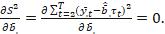
is the sum of squares of the residuals between the observed and predicted means. Then the value of  that minimises
  is given by
 (A1.8)
On simplification, Eq. (A1.8) reduces to
 (A1.9)
that is, in full,
 (A1.10)
It is evident that the least squares estimate of  is a function of
  .
.
Least squares estimate of  in the meta-metre jointly with an estimate of
To estimate  , consider again the sum of squares of the residuals of Eq. (A1.7). With
  explicit,

 (A1.11)
The value of  that minimises
  is given by
 (A1.12)
On some simplification, Eq. (A1.12) reduces to
 (A1.13)
that is, more simply,
 (A1.14)
Iterative steps in the estimates of 
Step 1: To obtain the least squares estimate of  for the population, first an initial value
  , which might even be
  depending on the value of
  , is chosen and inserted in Eq. (A1.10) to provide an estimate
Step 2: Both  and
and  are inserted in Eq. (A1.13), and if the value
  of Eq. (A1.13) is different from 0 to any degree of accuracy required, a new value
  is chosen. Step 1 is repeated to give a value
  that makes the value of Eq. (A1.13) closer to 0 than from the initial value. The iterative process is continued until values
  give a value of Eq. (A1.13) that is equal to 0 to any degree of accuracy, for example, three or four decimal places. This process gives the estimate of the value of
  and
and  for the population.
The estimate of an individual’s rate of growth
Given the estimate of  in the logarithmic meta-metre, the least squares estimate of an individual’s rate of growth
  is in the form of Eq. (A1.9), that is
 (A1.15)
where  are the differences of successive measurements of individual
  .
.
A1.2 Maximum likelihood (ML) estimates of individual parameters and their standard errors in the dichotomous Rasch model
The dichotomous Rasch model takes the form
 (A1.16)
where  is the probability of the correct response
  , where
  is a correct or incorrect response respectively, of individual
  to item
  . Then, given the item parameter estimates, the ML solution equation for the estimate
  is given by
 , (A1.17)
where  is the total score of individual
  on
on  items. The asymptotic ML variance of the estimates
  for each individual at each time of measurement is given by
 . (A1.18)
In the software employed in the analysis of data in this paper, RUMM2030Plus (Andrich, Sheridan & Luo, 2023), the item parameters are first estimated by conditioning out the individual parameters  by the approach described in Andrich and Luo (2003).
A1.3 Summary statistics of Simulations 1 and 2
Simulation 1
Table A1.1.
The parameter of the meta-meta  , summary statistics of the specified distribution, the simulated measures, and estimated measurements and recovery of the known true variance for the grades
  at each time of measurement
  for Simulation 1.
| ||||||||
| Row | |||||||
Occasion | 1 | 2 | 3 | 4 | 5 | 6 | 7 | 1 |
Grade | 0 | 2 | 3 | 6 | 8 | 9 | 12 | 2 |
Specified parameters | ||||||||
| -1.690 | -0.080 | 0.250 | 0.870 | 1.140 | 1.250 | 1.530 | 3 |
| 0.160 | 0.160 | 0.160 | 0.160 | 0.160 | 0.160 | 0.160 | 4 |
Simulated Measures | ||||||||
| -1.697 | -0.087 | 0.243 | 0.863 | 1.133 | 1.243 | 1.523 | 5 |
| 0.155 | 0.155 | 0.155 | 0.155 | 0.155 | 0.155 | 0.155 | 6 |
Estimated Measurements | ||||||||
| -1.702 | -0.086 | 0.238 | 0.877 | 1.139 | 1.243 | 1.532 | 7 |
| 0.296 | 0.262 | 0.271 | 0.282 | 0.286 | 0.274 | 0.295 | 8 |
Estimate of true variance from the error variance: | ||||||||
| 0.135 | 0.114 | 0.114 | 0.118 | 0.121 | 0.123 | 0.129 | 9 |
| 0.161 | 0.148 | 0.157 | 0.164 | 0.165 | 0.151 | 0.166 | 10 |
| 0.006 | -0.007 | 0.003 | 0.009 | 0.010 | -0.005 | 0.010 | 11 |







Rows 1 and 2 show grades at the time of measurement,  , Rows 3 and 4 are the summary statistics of the specified individual measures,
  of a normal distribution at each time, Rows 5 and 6 show the summary statistics of the observed simulated measures,
  , which are expected to be slightly different from the specified statistics, and Rows 7 and 8 show the estimated measurements
  obtained from the Rasch model analysis of the responses of the individuals to the 60 items of a test. The variances from the estimated measurements,
  are greater than from the known measures
  which is a direct result of the former having errors of measurement.
Although the error variance of individual estimates from Eq. (A1.2) are a function of the estimate  , the mean of these estimates can be taken as a guide to the overall error variance in the estimates. These means are shown in Row 9 as
  . Then an estimate of the true variance, denoted
  , is the difference between the estimated variances
  of Row 8, and the mean error variance that is
  . These are shown in Row 10. The magnitude of the greatest difference between the estimated and known true variance
  of Row 6,
 , shown in Row 11, is 0.01. This difference indicates that the ML estimates from the Rasch model are an excellent estimate of the error variance of each estimate.
Simulation 2
Table A1.2 shows the results of the analyses of the data in Simulation 2.
Table A1.2.
The parameter of the meta-meta  , summary statistics of the specified distribution, the simulated measures, and estimated measurements and recovery of the known true variance for the grades
  at each time of measurement
  for Simulation 2.
| ||||||||||
| Row | |||||||||
Occasion | 1 | 2 | 3 | 4 | 5 | 6 | 7 | 1 | ||
Grade | 0 | 2 | 3 | 6 | 8 | 9 | 12 | 2 | ||
Specified parameters | ||||||||||
| -1.690 | -0.080 | 0.500 | 0.870 | 1.140 | 1.350 | 1.530 | 3 | ||
| 0.160 | 0.160 | 0.160 | 0.160 | 0.160 | 0.160 | 0.160 | 4 | ||
Simulated Measures | ||||||||||
| -1.691 | -0.076 | 0.257 | 0.878 | 1.138 | 1.246 | 1.530 | 5 | ||
| 0.160 | 0.173 | 0.162 | 0.164 | 0.167 | 0.160 | 0.166 | 6 | ||
Estimated Measurements | ||||||||||
| -1.703 | -0.084 | 0.268 | 0.889 | 1.147 | 1.256 | 1.548 | 7 | ||
| 0.309 | 0.293 | 0.278 | 0.288 | 0.278 | 0.278 | 0.295 | 8 | ||
Estimate of true variance from the error variance: | ||||||||||
| 0.135 | 0.114 | 0.114 | 0.119 | 0.122 | 0.124 | 0.130 | 9 | ||
| 0.174 | 0.178 | 0.163 | 0.169 | 0.156 | 0.154 | 0.165 | 10 | ||
| 0.014 | 0.005 | 0.001 | 0.005 | -0.011 | -0.005 | -0.001 | 11 | ||







Unlike in Table A1.1 in which the variance of the measures,  , is the same (0.155) for all time points, in Table A1.2 this variance shows variation around 0.16. This variation is a direct result of non-uniform growth among individuals. The remaining estimates are consistent with the specifications, and with Table A1.1, including the estimate of the true variance
  from the mean of the individual error variances.
Appendix 2. The use of differences  , presence of regression and estimation equations in the dichotomous Rasch model
A2.1 The application of successive differences in estimation
Here we consider some features of taking successive differences in estimation. First, the effect of taking differences between measurements for purposes of estimation is analogous to taking differences in the t-test for a difference between means for dependent samples, for example, when the same individuals are measured on two occasions. The difference removes the common value, which is the source of the correlation between the two measurements across individuals. For example let  be a measurement at Time 1 and
 be a measurement at Time 2 where
  is the individual change from Time 1 to Time 2. Then
  eliminates the common value
  . Then the null hypothesis of no difference between means takes the simple form
 . (A2.1)
If the two times of measurement  were employed directly, rather than the differences
  which eliminate the dependence between the two times points, then the
denominator of Eq.(A2.1) takes the form

A2.2 Regression effects
However, in the case of more than two times of measurement, and despite the source of the correlation between successive measurements being removed, because of regression effects of normally distributed measurement error, the covariance between two successive differences  is most unlikely to be zero. The regression effect arises because in the normal distribution which is not only unimodal, but strictly log-concave making it smoothly unimodal (Andrich & Pedler, 2019), the probability of a large error is less than the probability of a small error, and if a large error is observed on one occasion, it is more likely that a smaller error will appear on a second occasion, and vice versa. To be explicit, suppose a random error on the first occasion gives a value 1.0 standard deviation above the true value. For a normal error distribution, this implies that only about 16% of the distribution is above this value. Therefore, with the same error distribution, there is about 84% chance that the error on the second occasion is less than 1 standard deviation of the previous value. That is, in the presence of random measurement error, there is regression to the true value. This effect is repeated for each subsequent occasion. This form of regression was shown in Section 4 where the results of two simulation studies are provided.
The concept of regression to the mean, or the true value, is not confined to normally distributed measurement errors – it is present in any unimodal distribution, including the normal distribution where no measurement error is concerned. For example, Bock (1975, Ch. 7) reports an example where a comparison of the change in means between two times of measurement between males and females is conducted by analysis of covariance, where the covariate is the measurement on the first occasion. Although there is no difference in mean change or gain measurements between men and women, an analysis of covariance shows a significant greater gain for men. This is because the analysis of covariance answers the question “Is a man expected to show a greater weight gain than a woman, given that they are initially of the same weight?”. For this example, the reason given for a greater gain for a man is that if “…initially of the same weight as the woman, he is either underweight and will be expected to gain, or the woman is overweight and will be expected to lose” (Bock, 1975, p. 491). This is an example of regression over time which is not concerned with measurement errors.
For the simulation examples in the paper, the regression effect arises similarly. Specifically, if an individual has a somewhat smaller than expected amount of growth between the first two times of measurement, then that individual is likely, though not certainly, to have a greater growth between the next two times of measurement. On the other hand, if the amount of growth is somewhat greater than expected between two times of measurement, then the individual is likely to have a smaller growth between the next two times of measurement.
PUBLISHED
ISSUE
